Home › Paul's journeys › Second Missionary Journey
Antioch
Antioch (return) · Antakya, Hatay, Turkey
After Paul had spent some time in Antioch, he traveled from place to place throughout the region of Galatia and Phrygia, strengthening all the disciples.Acts 18:23 · Berean Standard Bible
- Date
- c. AD 52
- With Paul
- Not stated
- What happened
- Spent some time
- Modern place
- Antakya, Turkey
The story

Acts says very little about this return. From Jerusalem, Paul "went down to Antioch", the church that had sent him out on his first journey and from which he had set out on this one.
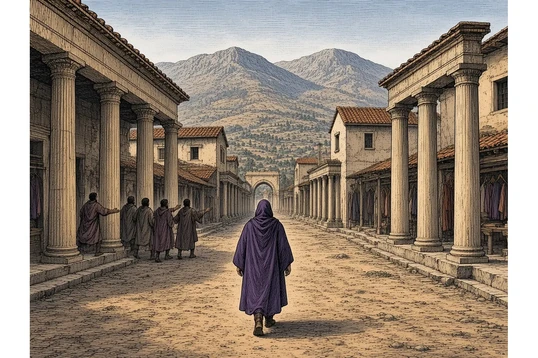
Now in the church at Antioch there were prophets and teachers: Barnabas, Simeon called Niger, Lucius of Cyrene, Manaen (who had been brought up with Herod the tetrarch), and Saul.Acts 13:1
After his first journey, Paul and Barnabas had gathered the church and reported all that God had done. Acts gives no such report this time. Luke says only that Paul spent some time there.
Then Paul set out again through Galatia and Phrygia, strengthening all the disciples. The second journey ends, and the third begins. Acts never records Paul returning to Antioch.
Acts gives no such report this time.
Then and now
In Paul's day
Today
The place in Paul's day
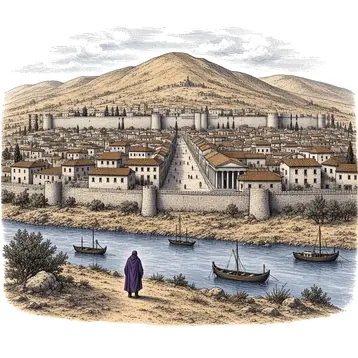
Antioch was the capital of the Roman province of Syria and the residence of its governor, one of the most senior posts in the empire, with several legions under his command. Founded by Seleucus in 300 BC, it filled the plain between the Orontes and the steep slopes of Mount Silpius, about 24 km inland from its port, Seleucia Pieria. Josephus credits Herod the Great with paving its long main street and lining it with colonnades. BiblePlaces says that by AD 165 it was the third largest city of the empire, though BiblicalTraining notes that no reliable population figures survive. About 8 km to the south lay Daphne, a wooded suburb with springs and a great sanctuary of Apollo. The city had a large Jewish community and a church of mixed Jewish and Gentile believers.
What you can see today
Antakya was badly damaged by the earthquakes of February 2023, and much of the modern city has been rebuilt or is being rebuilt. Little of ancient Antioch is visible, because the remains lie under the modern city and deep layers of silt from the Orontes. The cave church of St Peter on the slopes of Mount Silpius, long venerated as a meeting place of early believers, has a façade from the Crusader period; it reopened to visitors in January 2024 after repairs. The Hatay Archaeology Museum holds many of the mosaics found in the 1930s excavations. A local report in November 2026 gave September 2027 as the target for its full reopening.
Did you know?
- In the 4th century AD the orator Libanius, a native of Antioch, praised his city for lighting its streets at night.
- John Chrysostom, the most famous preacher of the early church, was born at Antioch about 347.
- Excavations in the 1930s explored the main street and the suburbs of Daphne and Seleucia Pieria. Their best-known finds are hundreds of floor mosaics.
How we know where it was
Antakya stands on the site of ancient Antioch on the Orontes, between the river and Mount Silpius, and has kept a form of the name. Excavations in 1932–1939 uncovered parts of the ancient city and its suburbs.
Uncertain or debated
Fewer paragraphs
Acts 18:22–23 gives only the barest outline, so this stop has three story paragraphs.
Where Paul came from
If the church of Acts 18:22 was in Caesarea, Paul came to Antioch directly from there (see Jerusalem).
Length of stay
"Some time" is not defined.
Peter's visit
BiblicalTraining notes that Paul's clash with Peter at Antioch (Galatians 2:11–14) may fall before or after the Jerusalem council. Some have placed it during this return visit; the sources consulted do not settle it.
The museum's reopening
Reports in February 2026 (used at stop 1) said the end of 2026; the Antakya Gazetesi report of 24 November 2026 gives September 2027.
Who excavated
BiblePlaces names Princeton and the Sorbonne; BiblicalTraining says Princeton and partner institutions.
The old bridge
The 1930s photo shows an old bridge over the Orontes. Its age and whether it survives were not verified.
Bible references
Acts 18:22, 23 (events Acts 18:22–23). Earlier: Acts 11:19–30; 13:1–3; 14:26–28; 15:30–40; Galatians 2:11.