Home › Paul's journeys › Second Missionary Journey
Jerusalem
Jerusalem
When Paul had landed at Caesarea, he went up and greeted the church at Jerusalem. Then he went down to Antioch.Acts 18:22 · Berean Standard Bible
- Date
- c. AD 52
- With Paul
- Not stated
- What happened
- Greeted the church (probably Jerusalem)
- Modern place
- Jerusalem
The story
Luke's account is shorter here than anywhere else on the journey. Having landed at Caesarea, Paul "went up and greeted the church", and then went down to Antioch. In the Greek the city is not named.

In Acts, "going up" is the usual term for travelling to Jerusalem, high in the Judean hills, and "the church" most naturally means the mother church there. So most interpreters, and the BSB, take it as Jerusalem. Some older scholars thought Luke meant the church at Caesarea.
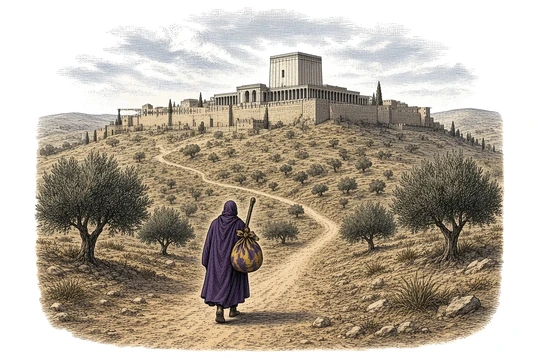
"Greeted" suggests a short visit. Luke mentions no meeting, no report and no visit to the Temple.
If this was Jerusalem, it was Paul's fourth visit in Acts. On the third, at the council, the church had welcomed Paul and Barnabas and heard what God had done among the Gentiles. James, the brother of Jesus, still led the church.
On their arrival in Jerusalem, they were welcomed by the church and apostles and elders, to whom they reported all that God had done through them.Acts 15:4
Paul would come back once more, at the end of his third journey. The believers welcomed him gladly, but in the Temple he was accused of bringing Gentiles into the inner courts, and was arrested.
When we arrived in Jerusalem, the brothers welcomed us joyfully.Acts 21:17
Luke's account is shorter here than anywhere else on the journey.
Then and now
In Paul's day
Today
The place in Paul's day
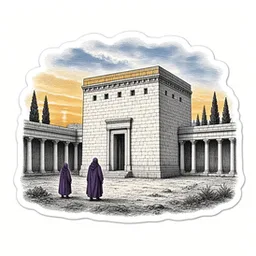
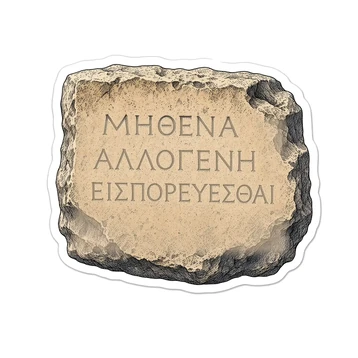
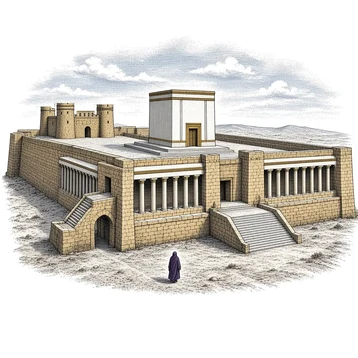
Jerusalem was the religious centre of the Jewish world, the goal of pilgrims from across the empire at the great feasts. It was governed from Caesarea by a Roman procurator, with a garrison in the Antonia fortress, which Herod had rebuilt at the north-west corner of the Temple courts. Herod's Temple dominated the eastern hill. He had doubled the old precinct, supporting the platform with massive retaining walls and vaults, and enclosed about 35 acres (14 ha). On the western hill stood Herod's palace, guarded by three great towers. Stone barriers inside the Temple courts carried Greek and Latin notices warning foreigners not to pass on pain of death. The church, led by James, was mostly made up of Jewish believers who remained "zealous for the law" (Acts 21:20).
What you can see today
Herod's Temple was burned in AD 70, and nothing of the sanctuary itself survives. What remains are parts of Herod's platform: the lower courses of the Western Wall, with their huge, finely dressed stones; the southern steps that led up to the gates in the southern wall; and the springing of Robinson's Arch, which once carried a stairway over the street below. Excavations along the southern and western walls have uncovered paved streets and shops of the Herodian city, and hundreds of architectural fragments attributed to the Royal Stoa. The Temple Mount itself carries later buildings and is administered by a Muslim trust.
Did you know?
- Two of the Temple's Greek warning inscriptions have been found, threatening death to any foreigner who went beyond the barrier. They show what lay behind the charge against Paul in Acts 21:28.
- Robinson's Arch is named after the American scholar Edward Robinson, who visited Jerusalem in 1838.
- Fragments attributed to the Royal Stoa show signs of having been burned at temperatures above 800 °C, consistent with the fire of AD 70.
How we know where it was
The city itself is certain. But the Greek of Acts 18:22 does not name Jerusalem, so whether Paul went there on this journey is an inference, accepted by most interpreters but not all (see below). The coordinates mark the Temple Mount as the best-known point of the ancient city; where the church met is not known.
Uncertain or debated
Does Acts 18:22 mean Jerusalem?
The Greek says only that Paul "went up and greeted the church". The UBS translators' handbook (via Translation Insights and Perspectives) notes that some translations name Jerusalem, among them Phillips, the Twentieth Century New Testament, Luther and An American Translation, while the Jerusalem Bible and the Zürcher Bibel explain it in notes. Commentaries collected on Bible Hub list Erasmus, Calvin, Beza, Grotius and Bengel among those who took it as Jerusalem, and others (including Kuinoel and Zahn) who took it as Caesarea. The Expositor's Greek Testament calls the Caesarea view "quite arbitrary".
The longer reading of Acts 18:21
If the words about keeping a feast in Jerusalem were original, they would settle the question. BiblicalTraining thinks they probably are not. Meyer's commentary says that if they are not genuine, the Caesarea reading would be necessary.
How many visits
Meyer counts this as Paul's fourth visit to Jerusalem in Acts. Matching the visits in Acts with those in Galatians 1–2 is debated.
Where the church met
Not found. No source consulted locates the meeting place of the Jerusalem church at this date.
The Temple platform area
BiblicalTraining gives about 35 acres (14 ha). Wikipedia describes a near-square courtyard of about 197.5 metres a side for an earlier platform, which Herod extended.
Bible references
Acts 18:22 (this visit, if it was Jerusalem). Paul's other visits: Acts 9:26; 12:25; 15:2, 4; 21:17; Galatians 1:18; 2:1.