Home › Paul's journeys › Second Missionary Journey
Thessalonica
Thessaloniki, Greece
Some of the Jews were persuaded and joined Paul and Silas, along with a large number of God-fearing Greeks and quite a few leading women.Acts 17:4 · Berean Standard Bible
- Date
- c. AD 49–50
- With Paul
- Silas (Timothy probably)
- What happened
- Synagogue, riot, Jason's bond
- Modern place
- Thessaloniki, Greece
The story
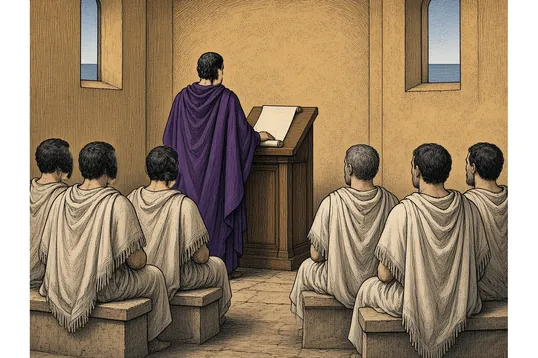
From Philippi, Paul and Silas travelled west along the Via Egnatia to Thessalonica, the leading city of Roman Macedonia. As usual, Paul went first to the synagogue. On three Sabbaths he reasoned from the Scriptures that the Christ had to suffer and rise from the dead, and that Jesus was the Christ.
Paul later reminded the believers that he had worked night and day so as not to be a burden. The church at Philippi sent him help more than once. So many interpreters think he stayed some weeks, perhaps a few months.
Surely you recall, brothers, our labor and toil. We worked night and day so that we would not be a burden to anyone while we proclaimed to you the gospel of God.1 Thessalonians 2:9
Opponents gathered troublemakers from the marketplace and raided the house of Jason, where the missionaries were staying. Not finding Paul and Silas, they dragged Jason before the city officials. Their charge was that these men proclaimed another king, Jesus. The officials took a bond and released them.
That night the believers sent Paul and Silas away to Berea. The church they left behind was mostly Gentile. Paul soon wrote to it from Corinth. BiblicalTraining counts 1 and 2 Thessalonians among the earliest of his surviving letters.
For they themselves report what kind of welcome you gave us, and how you turned to God from idols to serve the living and true God1 Thessalonians 1:9
The church they left behind was mostly Gentile.
Then and now
In Paul's day
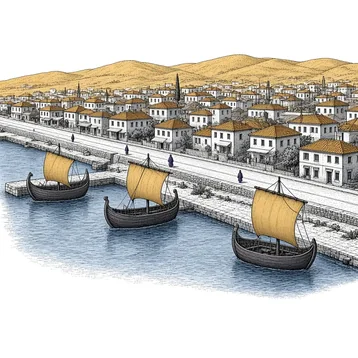
Today
The place in Paul's day
Cassander founded Thessalonica about 316–315 BC and named it after his wife, a half-sister of Alexander the Great. It grew into the chief port of the Macedonian kingdom, at the head of the Thermaic Gulf. Under Rome it was the residence of the governor of Macedonia, and the Via Egnatia used its main street. After backing the winning side at Philippi in 42 BC it became a "free city", keeping its own assembly and magistrates and largely spared Roman garrisons. Strabo called it the most populous city of Macedonia. Most people were Greek, alongside Roman officials, merchants and traders from across the eastern Mediterranean. Inscriptions show the worship of Greek gods, of Egyptian gods such as Isis and Sarapis, of a local protector god called the Cabirus, and public honours for Rome and the emperors.
What you can see today
Thessaloniki is now the second city of Greece, and the city of Paul's day lies mostly beneath it. Egnatia Street still roughly follows the line of the ancient main road. The Roman forum, uncovered during building work in the 1960s, can be seen in the city centre. Its visible remains, including a small theatre or odeum and colonnades, date mainly from the 2nd and 3rd centuries AD, with traces of earlier phases beneath. The Arch of Galerius and the Rotunda date from around AD 300, long after Paul. The city's early Christian and Byzantine monuments became a UNESCO World Heritage site in 1988.
Did you know?
- Acts calls the city's magistrates "politarchs". The title is almost absent from surviving Greek literature, and some critics once took it as a mistake, but many inscriptions using it have since been found, a good number in Thessalonica itself.
- The best-known politarch inscription was carved on the Vardar Gate, a Roman arch over the Via Egnatia that was demolished in 1876. The inscribed block is now in the British Museum.
- Aristarchus, "a Macedonian from Thessalonica" (Acts 27:2), later sailed with Paul towards Rome.
How we know where it was
The city has been lived in without a break since its founding and still bears the same name (Thessaloniki). Its Roman forum has been excavated in the city centre, and inscriptions found there use the title "politarch", which Acts gives to the city's officials.
Uncertain or debated
Length of stay
Acts mentions three Sabbaths. Paul's letters (1 Thessalonians 2:9; Philippians 4:16) suggest a longer stay, and many interpreters think of several weeks or a few months.
Was Timothy there?
Acts 17:1–10 names only Paul and Silas. BiblicalTraining assumes Timothy travelled with them; he is next named at Berea (Acts 17:14).
Date of the forum
BiblePlaces calls it a "1st or 2nd century AD forum", BiblicalTraining dates the visible remains mainly to the 2nd and 3rd centuries AD, and Wikipedia says it was "largely refurbished in the second century". BiblePlaces says it was revealed when a bus station moved in 1962; BiblicalTraining says "the 1960s".
Date of the Vardar Gate inscription
BiblePlaces gives 30 BC to AD 143.
Where Paul taught
Wikipedia says Paul taught in what is now the Upper City, but gives no evidence. The synagogue has not been located.
The bond
BiblicalTraining suggests it was a guarantee of no further trouble, which in practice kept Paul away. Some link it with "Satan blocked our way" (1 Thessalonians 2:18), but the text does not say.
2 Thessalonians
Many critical scholars doubt that Paul wrote it.
Bible references
Acts 17:1, 11, 13 (events Acts 17:1–9); 20:4; 27:2; Philippians 4:16; 1 Thessalonians 1:1; 2 Thessalonians 1:1; 2 Timothy 4:10.