Home › Paul's journeys › Second Missionary Journey
Berea
Berea (Beroea) · Veria, Imathia, Greece
Now the Bereans were more noble-minded than the Thessalonians, for they received the message with great eagerness and examined the Scriptures every day to see if these teachings were true.Acts 17:11 · Berean Standard Bible
- Date
- c. AD 50
- With Paul
- Silas and Timothy
- What happened
- Bereans test Paul's message
- Modern place
- Veria, Greece
The story
As soon as night had fallen, the believers in Thessalonica sent Paul and Silas away to Berea, about 72 km off the main Roman road. Cicero had called it "an out-of-the-way town". As usual, Paul went first to the synagogue.

The Bereans received the message eagerly and examined the Scriptures every day to see if Paul's teaching was true. They neither accepted nor rejected it out of hand. Many of them believed, along with prominent Greek women and men.
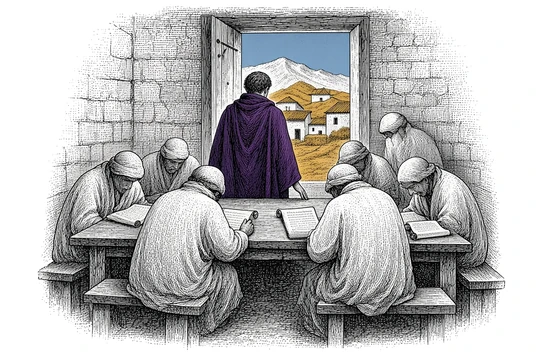
As a result, many of them believed, along with quite a few prominent Greek women and men.Acts 17:12
Then Jews from Thessalonica came and stirred up the crowds. The believers at once sent Paul to the coast, while Silas and Timothy stayed behind. His escorts took him all the way to Athens.
The brothers immediately sent Paul to the coast, but Silas and Timothy remained in Berea.Acts 17:14
One Berean is known by name. Sopater son of Pyrrhus later travelled with Paul at the end of the third journey, probably as a delegate carrying the collection for Jerusalem.
They neither accepted nor rejected it out of hand.
Then and now
In Paul's day
Today
The place in Paul's day
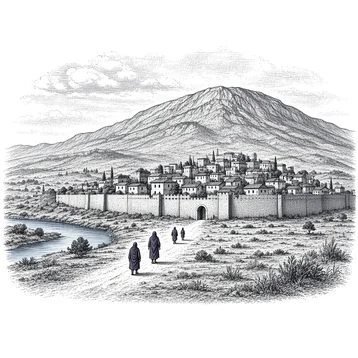
Berea stood at the eastern foot of Mount Bermius (modern Vermio), above the broad Macedonian plain, with the river now called Tripotamos along its western side. It lay in the heartland of the old Macedonian kingdom; the royal burial ground at Aigai (Vergina) is only a few miles away. When and by whom it was founded is unknown, but inscriptions show it existed by the late 4th century BC. After the Roman victory at Pydna in 168 BC it was among the first cities to surrender. Under the emperors it was a meeting place of the provincial council of Macedonia and a centre of emperor worship. The Via Egnatia passed some distance to the north. Acts shows a synagogue there, but none of the sources consulted locates it.
What you can see today
Berea is now Veria, the administrative centre of the Imathia region. Little of the ancient city stands above ground; Greece's Cultural Egnatia guide says only some sections of the walls are visible. Many Greek inscriptions from the Hellenistic and Roman periods have been recovered, and the city has an Archaeological Museum and a Byzantine Museum. Near Orologiou (Clock) Square, a monument erected in the early 1960s marks the place where, by tradition, Paul preached. Known as the Bema or "Step" of Paul, it is decorated with mosaics and visited by many pilgrims. A vespers service is held there every year on 29 June.
Did you know?
- Because of Acts 17:11, "Berean" has become a byword among Christians for people who test teaching carefully against Scripture. In 1773 the Scottish minister John Barclay founded a small denomination whose members called themselves Bereans.
- Veria's many old churches have earned it the nickname "Little Jerusalem".
- A later tradition names Onesimus as Berea's first bishop. BiblicalTraining says this cannot be confirmed.
How we know where it was
The city has been lived in continuously since antiquity and has kept its name almost unchanged (Beroia, now Veria or Veroia). Many Hellenistic and Roman inscriptions have been found there.
Uncertain or debated
The steps of the Bema
Discover Veria says the monument stands over Roman slabs of the 1st century on which, by tradition, Paul stood to preach. Holy Land Photos notes that some scholars suggest the steps date to about 1961. Nothing ties the spot to Paul except tradition.
Date of the visit
BiblicalTraining gives about AD 50. Wikipedia gives "AD 50/51 or 54/55". The Cultural Egnatia guide says "the middle of the 1st century BC", which appears to be a slip for AD.
How many visits
Discover Veria and the Cultural Egnatia guide say Paul visited twice. Acts records one visit. He may have passed through again on the third journey (Acts 20:1–3), but Luke does not say so.
Sea or land to Athens
Luke's wording allows either. BiblicalTraining thinks a sea voyage "perhaps the more natural reading".
Sopater and Sosipater
Some scholars identify Sopater with the Sosipater of Romans 16:21. The identification is possible but not certain.
Onesimus as bishop
The Cultural Egnatia guide names Onesimus as first bishop (61–106); BiblicalTraining says the tradition cannot be confirmed.
Bible references
Acts 17:10, 11, 13, 14 (events Acts 17:10–15); 20:4.