Home › Paul's journeys › Second Missionary Journey
Athens
Athens, Greece
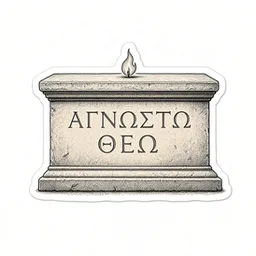
For as I walked around and examined your objects of worship, I even found an altar with this inscription: TO AN UNKNOWN GOD. Therefore what you worship as something unknown, I now proclaim to you.Acts 17:23 · Berean Standard Bible
- Date
- c. AD 50
- With Paul
- No companion named (Timothy briefly)
- What happened
- Speech at the Areopagus
- Modern place
- Athens, Greece
The story
Paul's escorts brought him to Athens, where he waited for Silas and Timothy. He was deeply disturbed to see the city full of idols. He reasoned in the synagogue, and every day in the marketplace with whoever was there.
While Paul was waiting for them in Athens, he was deeply disturbed in his spirit to see that the city was full of idols.Acts 17:16

Epicurean and Stoic philosophers debated with him. Some called him a "babbler", a word for a bird picking up seeds. Others thought he was advocating foreign gods, because he spoke of Jesus and the resurrection.
They brought him to the Areopagus, the ancient council named after the hill of Ares. Paul began by saying the Athenians were very religious, and pointed to an altar inscribed "TO AN UNKNOWN GOD".
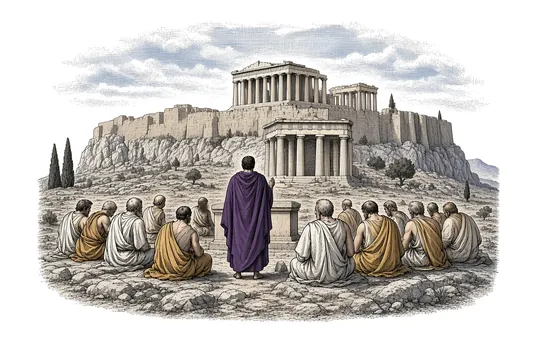
He spoke of the God who made the world and does not live in temples made by human hands, and quoted Greek poets. God now commanded all people to repent, he said, and had given proof by raising a man from the dead.
At the mention of resurrection some mocked, while others wanted to hear more. A few believed, among them Dionysius, a member of the council, and a woman named Damaris. Paul then left for Corinth.
But some joined him and believed, including Dionysius the Areopagite, a woman named Damaris, and others who were with them.Acts 17:34
At the mention of resurrection some mocked, while others wanted to hear more.
Then and now
In Paul's day
Today
The place in Paul's day
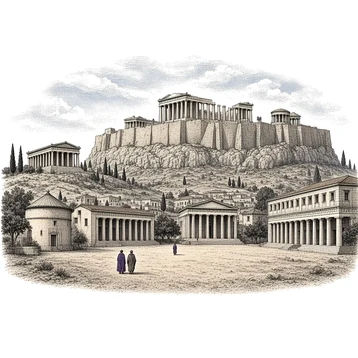
By the middle of the 1st century AD Athens was smaller and poorer than in its prime, but its monuments were largely intact and it remained a free city and a respected centre of philosophy. Travellers entered by the Dipylon Gate and followed the Panathenaic Way through the agora, the civic and commercial heart, towards the Acropolis. On the agora's west side stood the round Tholos, the council house, the Metroon, which held the public archives, and the Royal Stoa, with the Temple of Hephaestus on the low hill above. The long Stoa of Attalus lined the east side. Under Augustus a Roman market and a concert hall had been added, and a temple of Ares had been moved into the agora. On the Acropolis stood the Parthenon and a newer small round temple to Roma and Augustus.
What you can see today
Athens is the capital of Greece, and its ancient centre is among the most thoroughly studied anywhere. The American School of Classical Studies has excavated the agora since 1931. Visitors can walk among its foundations, see the well-preserved Temple of Hephaestus, and visit the Stoa of Attalus, rebuilt in the 1950s as a museum. The Areopagus is a bare limestone outcrop below the Acropolis, climbed by a worn flight of steps cut into the rock. A bronze plaque near the foot of the steps carries the Greek text of Paul's speech. On the northern slope lie the ruins of a church dedicated to Dionysius the Areopagite.
Did you know?
- No altar with Paul's exact inscription has been found. But the 2nd-century travel writer Pausanias mentions altars of "gods called unknown" on the road from the harbour at Phaleron.
- The writings that later circulated under the name of Dionysius the Areopagite were composed around AD 500. Scholars now call their author Pseudo-Dionysius.
- The name of the ancient council lives on: the Supreme Court of modern Greece is called the Areios Pagos.
How we know where it was
Athens has never moved, and the Areopagus is the rocky hill below the Acropolis that has always carried the name. Whether Paul spoke on the hill itself, or before the council of the Areopagus meeting elsewhere, is debated (see below).
Uncertain or debated
Hill or council
Most modern scholars, according to BiblicalTraining, take "Areopagus" in Acts 17 to mean the council. Wikipedia says the council probably no longer met on the hill by Paul's time, but in the agora or the Royal Stoa. BiblePlaces says most see the reference as only the location of his preaching.
Hearing or trial
Scholars debate whether this was a formal inquiry or an informal request to explain the teaching. Luke's account gives no sign of a trial.
How Paul arrived
BiblePlaces says most scholars think he came by sea and so through the port of Piraeus. BiblicalTraining says Luke's wording allows sea or land.
Timothy in Athens
Acts 18:5 has Silas and Timothy rejoin Paul at Corinth. 1 Thessalonians 3:1–2 implies that Timothy reached Athens and was sent back to Thessalonica.
The poets
"In Him we live and move" is often traced to a poem attributed to Epimenides. "We are His offspring" comes from Aratus, a thought also found in Cleanthes.
The synagogue
Its site is unknown. A marble slab from near Mount Hymettus, once thought to mark it, is now dated much later.
First converts in Achaia
Paul calls Stephanas's household the first converts in Achaia (1 Corinthians 16:15), although Athens lay in that province. Explanations differ.
Height of the Areopagus
BiblicalTraining gives the summit as about 115 m above sea level. BiblePlaces says it stands 43 m (140 feet) below the Acropolis.
Bible references
Acts 17:15, 16, 19, 21, 22, 33 (events Acts 17:15–34); 18:1; 1 Thessalonians 3:1.