Home › Paul's journeys › Second Missionary Journey
Corinth
Ancient Corinth, Corinthia, Greece
One night the Lord spoke to Paul in a vision: “Do not be afraid; keep on speaking; do not be silent.Acts 18:9 · Berean Standard Bible
- Date
- c. AD 50–52
- With Paul
- Aquila, Priscilla; later Silas, Timothy
- What happened
- Eighteen months; Gallio dismisses case
- Modern place
- Ancient Corinth, Greece
The story

Paul came from Athens to Corinth, the capital of Achaia. There he found Aquila and Priscilla, Jews recently arrived from Italy because Claudius had ordered the Jews to leave Rome. They shared his trade, and he lived and worked with them.
and he stayed and worked with them because they were tentmakers by trade, just as he was.Acts 18:3
Every Sabbath Paul reasoned in the synagogue. When Silas and Timothy arrived from Macedonia, he gave himself fully to the word. Opposition grew, and he shook out his garments and turned to the Gentiles.
He moved next door, to the house of Titius Justus, a worshipper of God. Crispus, the synagogue leader, believed with his whole household, and many Corinthians were baptised.
One night the Lord told Paul in a vision not to be afraid, because he had many people in this city. Paul stayed a year and a half.
While Gallio was proconsul, opponents brought Paul before the judgement seat. Gallio refused to hear the case: it was a dispute about words and names and their own law. The crowd beat Sosthenes, the synagogue leader, and Gallio took no notice.
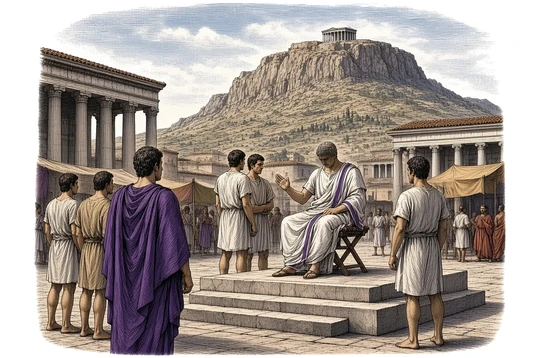
But since it is a dispute about words and names and your own law, settle it yourselves. I refuse to be a judge of such things.”Acts 18:15
Paul stayed a year and a half.
Then and now
In Paul's day
Today
The place in Paul's day
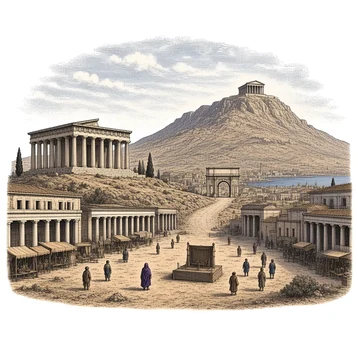
Rome had destroyed the old Greek city in 146 BC. In 44 BC Julius Caesar refounded it as a Roman colony, Colonia Laus Iulia Corinthiensis, and many of the first settlers were freedmen from Italy. Latin was its official language, though much of the population spoke Greek. It was the capital of Achaia, governed again by a proconsul after AD 44. Corinth stood below Acrocorinth, its steep citadel, and controlled the isthmus and two harbours: Lechaeum to the west and Cenchreae to the east. Its wealth came from trade, manufacturing, Corinthian bronze and government. It ran the Isthmian Games every two years. The population included colonists' descendants, Roman officials, Greeks, eastern immigrants and a Jewish community with a synagogue.
What you can see today
The excavated city lies beside the village of Ancient Corinth. The American School of Classical Studies has worked there almost continuously since 1896, and most of what is visible belongs to the Roman city. The seven standing columns of the Temple of Apollo, built about 540 BC, still dominate the site. Visitors can walk the large forum, lined with rows of shops, and see at its centre a marble-faced platform generally identified as the bēma where Paul faced Gallio. The paved Lechaeum Road leads north past the Peirene fountain. Near the theatre, a Latin inscription records that an Erastus paved a square at his own expense.
Did you know?
- A letter of the emperor Claudius inscribed at Delphi names "Junius Gallio, my friend and proconsul". It allows Gallio's year to be dated, usually to AD 51–52, and is the firmest fixed point in the chronology of Paul's life.
- Gallio was the elder brother of the Stoic philosopher Seneca.
- In Romans, written from Corinth, Paul passes on greetings from "Erastus, the city treasurer" (Romans 16:23).
How we know where it was
The excavated Roman city lies beside the village of Ancient Corinth, below the citadel of Acrocorinth. It has been dug almost continuously since 1896, and its standing Temple of Apollo has marked the site throughout.
Uncertain or debated
Gallio's dates
BiblicalTraining says most scholars date his year from summer AD 51 to summer 52, and a minority to 52–53. BiblePlaces gives "June 51 to May 52".
Claudius's expulsion
The order that brought Aquila and Priscilla from Rome is "usually dated to AD 49".
The bēma
The platform is "generally identified" with the judgement seat, not proved.
Erastus
The inscription's Erastus is probably, but not certainly, the Erastus of Romans 16:23. Scholars debate whether Paul's Greek title matches the Latin office of aedile. BiblePlaces dates the find to 1929.
Sosthenes
Whether he is the "brother Sosthenes" of 1 Corinthians 1:1 is uncertain. Manuscripts differ over who beat him.
Titius or Titus
BiblicalTraining gives Titius Justus; the BSB reads "Titus Justus".
Tentmakers or leatherworkers
BiblicalTraining and BiblePlaces both allow either meaning.
Height of Acrocorinth
BiblicalTraining gives about 575 m; BiblePlaces says about 550 m above the surrounding plain.
The city's reputation
Strabo's thousand temple prostitutes, and old population figures of several hundred thousand, are doubted by many modern scholars.
Bible references
Acts 18:1, 8, 11, 18 (events Acts 18:1–18); 19:1; 1 Corinthians 1:2; 2 Corinthians 1:1, 23; 6:11; 2 Timothy 4:20.