Home › Paul's journeys › Second Missionary Journey
Caesarea
Caesarea (Caesarea Maritima) · Caesarea, Israel
When the brothers learned of this, they took him down to Caesarea and sent him off to Tarsus.Acts 9:30 · Berean Standard Bible
- Date
- c. AD 52
- With Paul
- Not stated
- What happened
- Paul lands; few details
- Modern place
- Caesarea, Israel
The story
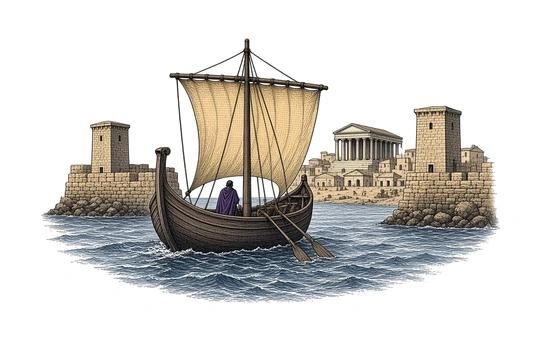
Leaving Ephesus, Paul sailed east and landed at Caesarea, the port of Judea and the seat of its Roman governors. Luke records only the landing, and gives no details of the stay.
Caesarea was not new to Paul. Years earlier the believers had brought him here and sent him by sea to Tarsus. Philip the evangelist lived here, and the centurion Cornelius had heard the gospel from Peter here.
At Caesarea there was a man named Cornelius, a centurion in what was called the Italian Regiment.Acts 10:1
Paul would return twice more: first to stay with Philip, and later as a prisoner, held for two years before sailing for Rome.
Leaving the next day, we went on to Caesarea and stayed at the home of Philip the evangelist, who was one of the Seven.Acts 21:8
Caesarea was not new to Paul.
Then and now
In Paul's day
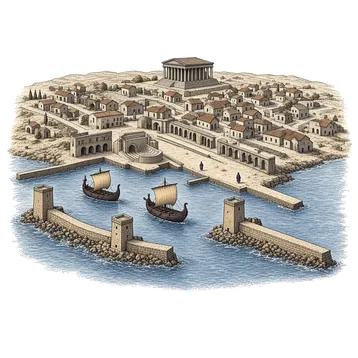
Today
The place in Paul's day
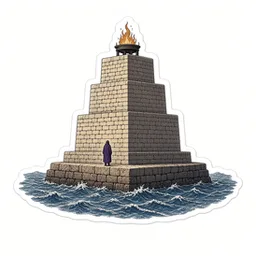
Herod the Great built Caesarea from about 22 BC on the site of a small anchorage called Strato's Tower, dedicating it about 10 or 9 BC and naming it after Augustus. Its great harbour, Sebastos, was built out into the open sea with stone blocks and Roman hydraulic concrete that set underwater. BiblePlaces says it could hold 300 ships. On a raised platform facing the harbour stood a temple of Roma and Augustus, visible far out at sea. The city had a street grid, a theatre facing the sea, a palace on a promontory, and an aqueduct bringing water from springs near Mount Carmel. From AD 6 it was the residence of the Roman governors of Judea and the main base of their troops. Its mixed Jewish and Gentile population often clashed.
What you can see today
The ancient city is now Caesarea National Park, beside the modern town of Caesarea. Herod's theatre has been restored and is in use again. Visitors can see the remains of the promontory palace by the sea, the temple platform overlooking the harbour, the long hippodrome by the shore, warehouses and stretches of the arched aqueduct that brought water from near Mount Carmel. Herod's harbour has mostly sunk; underwater surveys since 1980 have mapped its submerged breakwaters. The Pilate inscription found in the theatre is now in the Israel Museum in Jerusalem. Much of what stands by the harbour, including the walled town, is Crusader work.
Did you know?
- In 1961 an Italian team excavating the theatre found a reused limestone block with a Latin dedication naming Pontius Pilate as prefect of Judea. BiblicalTraining calls it the only known inscription from Pilate's lifetime that names him.
- Herod's harbour builders used concrete made with volcanic ash brought from Italy, which hardened underwater inside wooden forms. BiblicalTraining calls it one of the earliest known uses of the technique on such a scale.
- Luke's "we" passages place him with Paul at Caesarea (Acts 21:8; 27:1), so he may have gathered material for his Gospel and Acts during Paul's two years there.
How we know where it was
The Arabic form of the name, Qaisariyeh, survived at the site into modern times. Excavations since 1959 have uncovered Herod's harbour, theatre and palace, and an inscription naming Pontius Pilate.
Uncertain or debated
Choice of key verse
Acts 18:22, the only verse about this visit, is kept for the Jerusalem stop so that no verse is used twice. Acts 9:30, Paul's first known visit to Caesarea, is used here instead.
Did Paul meet the church here?
Some older commentators argued that "greeted the church" in Acts 18:22 means the church in Caesarea, not Jerusalem (see Jerusalem). On that view Caesarea, not Jerusalem, is where Paul greeted the believers.
Paul's prison
Acts 23:35 says Paul was kept in "Herod's Praetorium". Many scholars identify this with the promontory palace, but this is not certain.
Prison letters from Caesarea?
A minority of scholars propose that Paul wrote one or more of the prison letters here. Most still favour Rome, and some favour Ephesus.
Harbour size
BiblePlaces gives 40 acres (16 ha) and room for 300 ships. These are estimates.
How long after his conversion
"About fifteen years" is an approximation based on the usual dating of Paul's conversion to the early or mid-30s AD.
Bible references
Acts 8:40; 9:30; 10:1, 24; 11:11; 12:19; 18:22; 21:8, 16; 23:23, 33; 25:1, 4, 6, 13. (Matthew 16:13 and Mark 8:27 refer to Caesarea Philippi, a different city.)