Home › Paul's journeys › Second Missionary Journey
Ephesus
near Selçuk, İzmir Province, Turkey
But as he left, he said, “I will come back to you if God is willing.” And he set sail from Ephesus.Acts 18:21 · Berean Standard Bible
- Date
- c. AD 52
- With Paul
- Priscilla and Aquila
- What happened
- Brief synagogue visit
- Modern place
- Near Selçuk, Turkey
The story
Acts gives this visit only three verses. Paul, Priscilla and Aquila reached Ephesus, the leading city of Asia. Paul left the couple there. He went into the synagogue and reasoned with the Jews.
When they reached Ephesus, Paul left Priscilla and Aquila. He himself went into the synagogue there and reasoned with the Jews.Acts 18:19
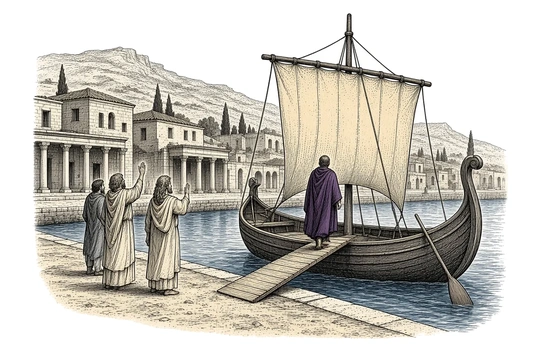
His hearers asked him to stay longer. He declined, but promised to come back if God was willing. Then he set sail from Ephesus.
Priscilla and Aquila stayed on. Soon Apollos arrived, and the couple explained the way of God to him more accurately. Paul kept his promise and returned on his third journey.
He declined, but promised to come back if God was willing.
Then and now
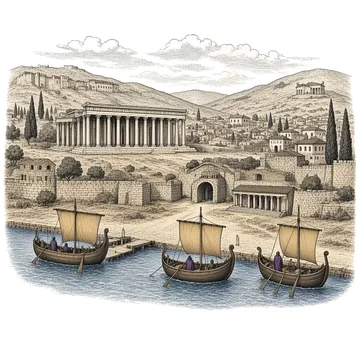
In Paul's day
Today
The place in Paul's day
Ephesus stood near the mouth of the Cayster River, between Mount Pion and Mount Koressos, with a harbour linked to the sea. Travellers between Rome and the eastern provinces often passed through. It was the usual residence of the Roman proconsul of Asia, and inscriptions call it "the first and greatest metropolis of Asia". Its fame rested above all on the Temple of Artemis, one of the Seven Wonders of the ancient world, which stood outside the city and drew pilgrims and wealth from across the region. Trade and the making of shrines and statues for the goddess's cult also made it rich. The Cayster's silt kept filling the harbour, which had to be dredged again and again. A large Jewish community lived there.
What you can see today
Ephesus is one of the most completely uncovered ancient cities in the Mediterranean and became a UNESCO World Heritage Site in 2015. Visitors walk Curetes Street and the marble street, past the remains of the agora, the council chamber and the terrace houses. Most of what stands, including the façade of the Library of Celsus (early 2nd century AD), is later than Paul. The great theatre on the slope of Mount Pion was enlarged in stages and in its final form seated about 24,000. The colonnaded Arcadian Way once led to the harbour, but silting has left the sea several miles away. Of the Temple of Artemis, only foundations and a single column remain.
Did you know?
- Paul kept his promise: on his third journey he returned and stayed about three years (Acts 19:1; 20:31).
- "Ephesian letters" was an ancient name for written magic spells. Luke later describes a bonfire of magic books at Ephesus (Acts 19:19).
- Two marble statues of Artemis found at Ephesus in 1956 are now in the museum at Selçuk.
How we know where it was
The ruins near Selçuk have been excavated by the Austrian Archaeological Institute almost continuously since 1895. Inscriptions, the theatre and the site of the Temple of Artemis identify the city beyond doubt.
Uncertain or debated
The longer reading of Acts 18:21
Some manuscripts add that Paul must keep the coming feast in Jerusalem. BiblicalTraining says this is probably not original. It matters for the next two stops, because without it Acts never says Paul planned to go to Jerusalem.
Population
BiblicalTraining says many estimates give 200,000 or more. Wikipedia calls such figures unrealistic.
Theatre capacity
BiblicalTraining and Wikipedia give about 24,000; BiblePlaces gives 25,000.
Date of the Library of Celsus
BiblePlaces gives AD 115–125; others say simply early 2nd century.
Where the synagogue stood
Not found.
Fewer paragraphs
Acts 18:19–21 is very brief, so this stop has three story paragraphs instead of four to six.
Bible references
Acts 18:19, 21, 24 (events Acts 18:19–21); 19:1; 1 Corinthians 15:32; 16:8; Ephesians 1:1; 1 Timothy 1:3; Revelation 2:1.