Home › Paul's journeys › Second Missionary Journey
Cenchreae
Cenchreae (Kenchreai; BSB "Cenchrea") · Kechries, Corinthia, Greece
Paul remained in Corinth for quite some time before saying goodbye to the brothers. He had his head shaved in Cenchrea to keep a vow he had made, and then he sailed for Syria, accompanied by Priscilla and Aquila.Acts 18:18 · Berean Standard Bible
- Date
- c. AD 51–52
- With Paul
- Priscilla and Aquila
- What happened
- Hair cut for a vow
- Modern place
- Kechries, near Corinth, Greece
The story
After his long stay in Corinth, Paul set out for Syria with Priscilla and Aquila. Their port was Cenchreae, Corinth's eastern harbour. Before he sailed, Luke says, he had his hair cut off because of a vow.
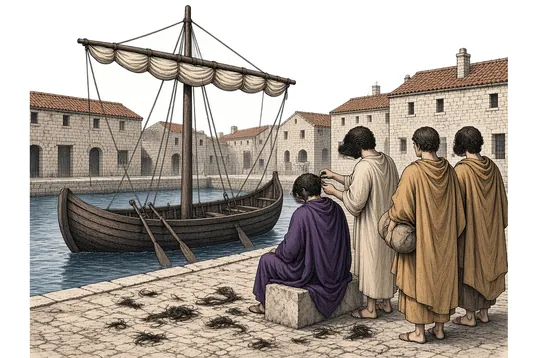
Luke does not explain the vow. Some link it with the Nazirite vow, though that hair was normally shaved in Jerusalem. Others think of a private vow of thanksgiving, made during the hard months in Corinth.
Some years later Paul commended to the church in Rome "our sister Phoebe", who served the church in Cenchreae. By then there was a congregation in the port. Phoebe probably carried the letter to Rome.
I commend to you our sister Phoebe, a servant of the church in Cenchrea.Romans 16:1
Luke does not explain the vow.
Then and now
In Paul's day
Today
The place in Paul's day
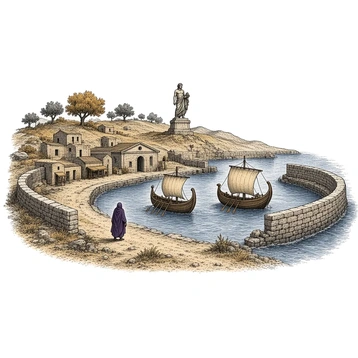
Cenchreae lay on a sheltered bay about 11 km by road from Corinth. Corinth controlled two harbours: Lechaeum faced west towards Italy, Cenchreae east towards Asia Minor, Syria and Egypt. Ships could also cross the narrow isthmus by the diolkos, a paved trackway in use from about 600 BC, which ran somewhat to the north of both harbours. The whole region was sacred to Poseidon, whose great sanctuary at nearby Isthmia hosted the Isthmian Games. The 2nd-century traveller Pausanias saw in Cenchreae a temple of Aphrodite, a bronze statue of Poseidon on a mole running into the sea, and sanctuaries of Asclepius and of the Egyptian goddess Isis. Its population was mixed: Greeks, Romans, Jews, traders and sailors.
What you can see today
Kechries is a small village of a few hundred people, about 8 km south-east of modern Corinth, surrounded by olive groves, vines and fruit trees. Because the coast has sunk since antiquity, much of the ancient port lies under shallow water. The outlines of the crescent-shaped harbour and its moles can be traced, along with the stone foundations of warehouses and harbour buildings on the southern side. Remains of a later Christian basilica stand near the site. Finds from the excavations, including some of the cut-glass panels found in crates near the harbour, are stored at the Archaeological Museum of Isthmia, where some are on display.
Did you know?
- The name Kenchreai is usually connected with the Greek word for millet. Greek legend instead said the two harbours were named after Kenchrias and Leches, sons of Poseidon.
- The Roman novel The Golden Ass by Apuleius sets its hero's conversion to the worship of Isis on the shore at Cenchreae.
- More than a hundred 4th-century panels of cut coloured glass were found still packed in crates, apparently never installed. They show Nile scenes, harbour views and famous writers and thinkers.
How we know where it was
The modern village of Kechries keeps the ancient name and stands at the same place, on a bay at the western end of the Saronic Gulf. The ancient harbour, partly under shallow water, has been excavated there.
Uncertain or debated
Whose vow
The Greek could refer to Aquila. Most interpreters take it as Paul's.
What kind of vow
A Nazirite vow (Numbers 6) or a private vow. A Nazirite's hair was normally shaved in Jerusalem, at the end of the vow. Luke gives no explanation.
Phoebe's title
The Greek diakonos (BSB "servant") can mean servant or minister in general, or a recognised church office of deacon. Interpreters differ. Her other title, prostatis (Romans 16:2), usually means a patron or benefactor.
Dates of the excavation
BiblicalTraining gives 1963–1968, by a team from the University of Chicago and Indiana University under Robert Scranton. Wikipedia gives 1962–1969 and calls the team sponsored by the American School of Classical Studies. The ASCSA's own history describes the excavations under Scranton and Edwin Ramage.
The Isis temple
The harbour remains are "identified by many" with the sanctuary of Isis described by Pausanias; this is not certain.
Did Paul sail from here again?
In Acts 20:3 Paul planned to sail for Syria from Greece but changed his route. Luke does not name the port.
The harbour tower
None of the sources consulted dates it. Not found.
Not found:
no openly licensed photo of the glass panels was found on Commons.
Bible references
Acts 18:18; Romans 16:1.